Blog Tips
How to do a weekly review in 15 minutes
A weekly review fits in 15 minutes if you give it three jobs and 5 minutes each. First, sweep everything that is on your mind and in your inboxes onto one page. Second, triage every item on that page: give it a date, make it smaller, or close it honestly. Third, pick the 3 outcomes that would make the coming week a good one. Set a timer, and stop when it rings.
The weekly review itself is David Allen’s, from Getting Things Done. His version is longer, and this one is a deliberately short cut of it. The argument for the short cut is simple: a review that fits a kitchen timer is one you will still be doing in March.
Why a weekly review at all
Daily planning decides today. Weekly planning decides what today is for.
If you only plan in the morning, every morning starts with the same expensive question: of everything I could do, what now? Answer it once a week, with the whole week in view, and the daily question shrinks to “which of the things I already chose?” You batch the decisions, then spend the week carrying them out.
It also gives loose ends somewhere to land. The half-promise made in a corridor, the thing from the voice note, the form you meant to send: a week is long enough for these to pile up and short enough that you can still remember them.

What the GTD weekly review is, and why this one is shorter
In Getting Things Done (2001, rewritten as a revised edition in 2015), Allen makes the weekly review part of the system. On the official GTD site he lays it out as 11 steps in 3 stages:
- Get Clear: collect loose papers and materials; get “In” to zero; empty your head.
- Get Current: review action lists; review past calendar data; review the upcoming calendar; review the Waiting For list; review project lists; review any relevant checklists.
- Get Creative: review Someday/Maybe; be creative and courageous.
That is a thorough review of a thorough system, and it assumes you have the system: action lists, a Waiting For list, a Someday/Maybe list. One productivity site that teaches the method recommends blocking “a full hour at least”. The GTD site itself is relaxed about frequency: “any time, any frequency, is better than not at all”.
The 15-minute version borrows the shape. Sweep is a compressed Get Clear. Triage does the work of Get Current, applied to a single list. Picking 3 stands in for Get Creative, aimed at the week ahead. It is a practice rather than a finding: 15 minutes is a choice, not a measured optimum. It is the length that tends to survive a busy week, and a review you skip because it takes an hour does not do much.
Step 1: sweep (5 minutes)
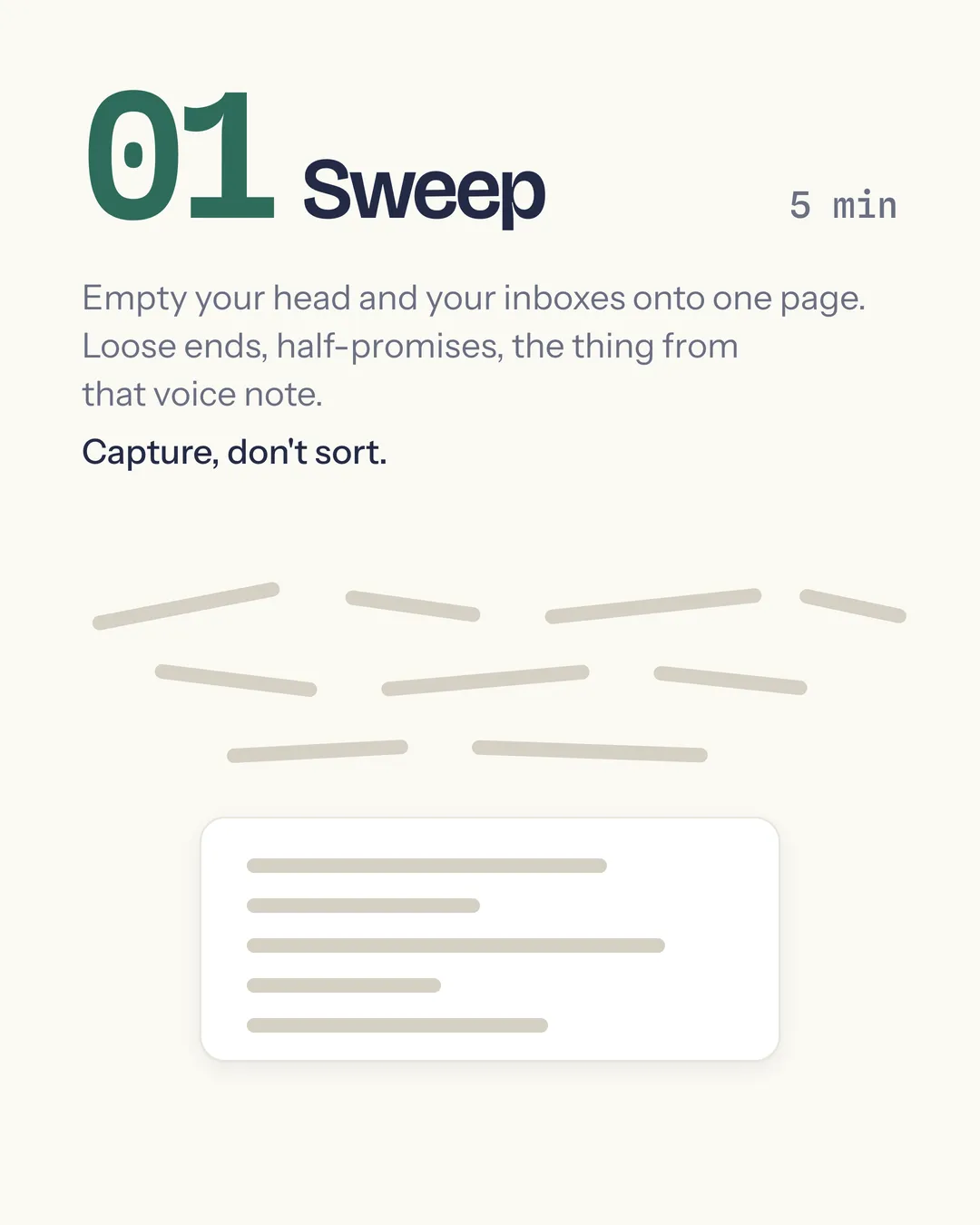
Empty your head and your inboxes onto one page. A paper notebook works; so does a single note on your phone. What matters is that there is exactly one place to look afterwards.
Include:
- the open tabs, the unanswered messages, the flagged emails;
- anything you said you would do for someone;
- last week’s list, with whatever did not get done;
- the thing you have been not-thinking about.
The rule is capture, don’t sort. Do not decide anything during the sweep, do not start answering emails, and do not tidy. A sweep that stops to judge every item turns into the 2-hour version. If you notice your pen hovering over one line, write the next one.
There is a longer discussion of why unfinished things keep tugging at attention in the Zeigarnik effect post. For the review, the practical point is smaller: things on a page are easier to leave alone than things in your head.
Step 2: triage (5 minutes)
Read down the page once. Every item gets one of 3 fates, and no item gets read twice.
Give it a date. The item is real and you want it done, so it goes on a specific day. Pick the type of date honestly: some things happen on a day (the dentist at 9:30), and some are due by a day (the form that must be in by Friday). The difference matters, and on a date or by a date goes into it. A task with no date is a wish with a checkbox.
Make it smaller. Some items sit on lists for weeks because they are really projects. “Sort out the tax thing” is not something you can start on a Tuesday. Rewrite it as the next visible step: “find last year’s return and put it on the desk”. Then give that a date too.
Close it honestly. Some things you are never going to do. Cross them out and write why, in a few words: “no longer relevant”, “someone else did it”, “decided not to”. This is the fate people skip, and it is where lists get light. Closing an item honestly is different from letting it quietly rot. You decided, and you can write the decision down.
The 5 minutes forces speed on purpose. Decide in a few seconds, and if you cannot, the item is too big: make it smaller and move on.

Step 3: pick 3 (5 minutes)
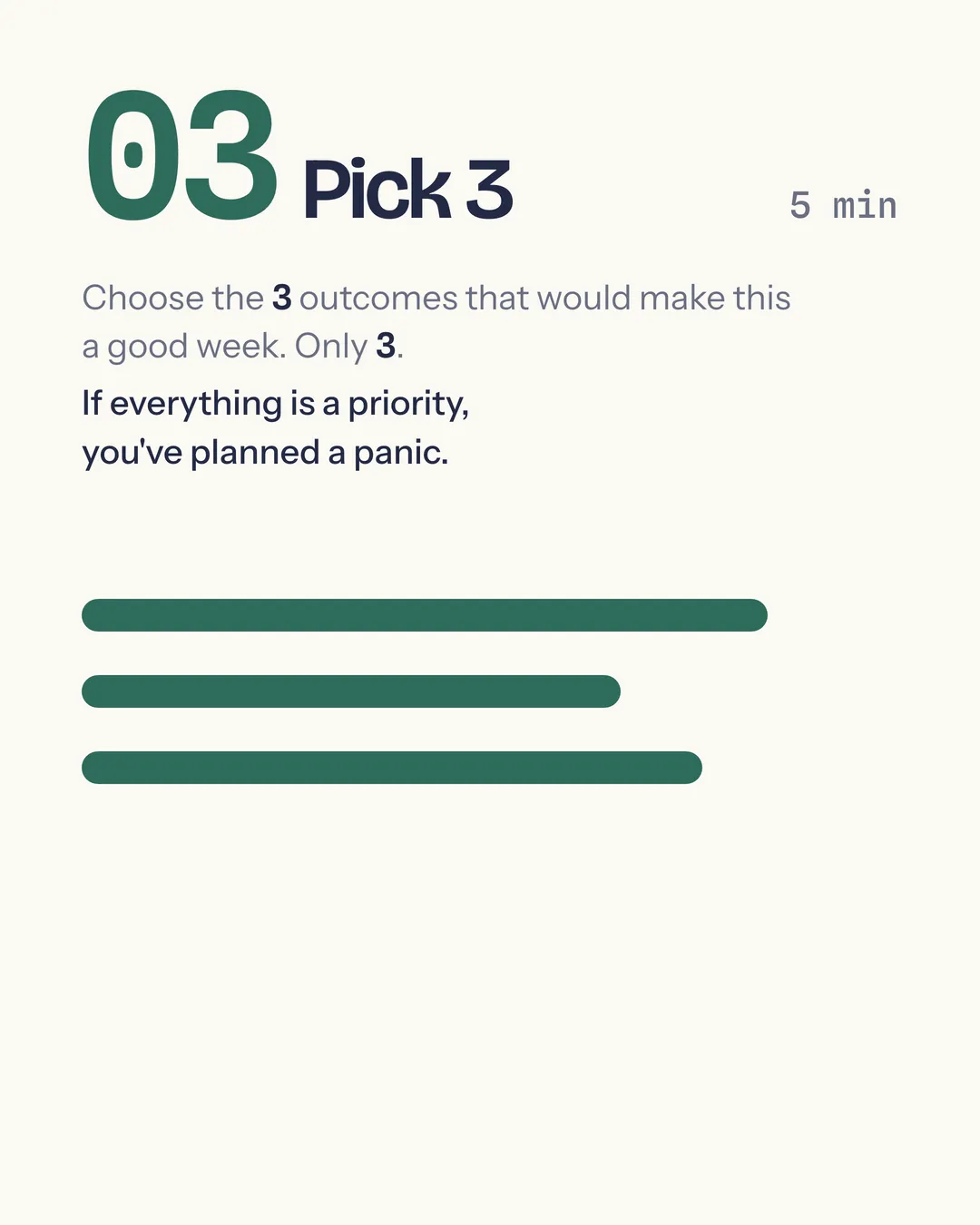
Now look at what is left, dated and shrunk, and choose the 3 outcomes that would make this a good week. Only 3.
An outcome is a result, not a topic. “Tax return filed” is an outcome. “Taxes” is a worry. Write each one so that on Friday you could say plainly whether it happened.
Three is a cap, not a target. If everything is a priority, you have planned a panic, and a Wednesday that goes wrong will take all of them with it. With 3, a Wednesday that goes wrong costs you a little, and you can see which of them to protect. Everything that did not make the 3 is still on its date; it has just not been promoted.
The same idea scaled down to a single day is in how to plan your day in three lines. The weekly 3 set the direction, and the daily lines fit them into a Tuesday.
When the review runs over
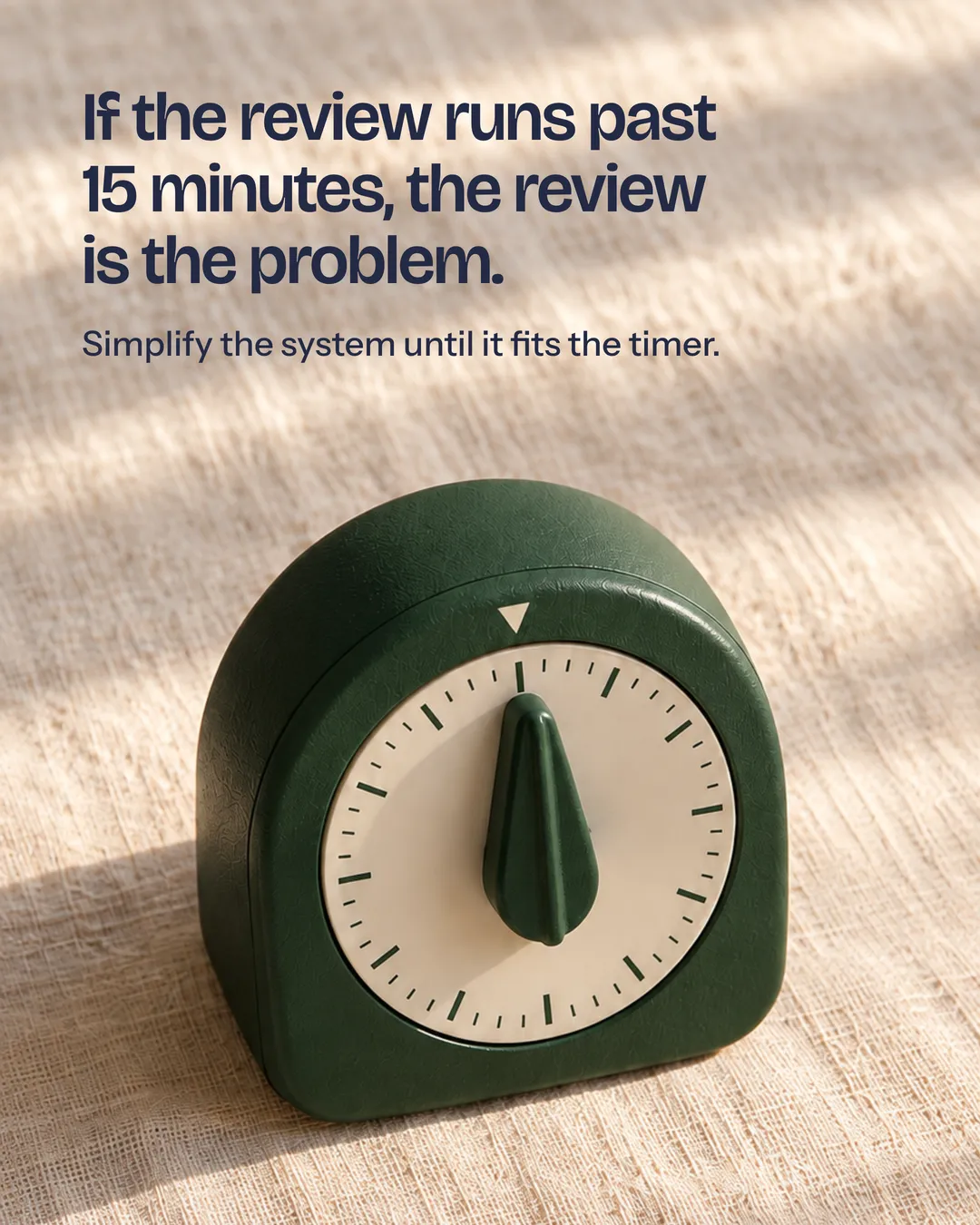
If the review runs past 15 minutes, the review is the problem. Simplify the system until it fits the timer.
In practice, cut in this order:
- Stop reading old items closely. Sweep captures; it does not re-examine.
- Cut the sweep sources. If you have 6 inboxes, sweep 3 this week and add the rest back one at a time.
- Make the list shorter at the source. A long page means too much comes in, so close more items in step 2.
- Never cut step 3. If you only have 5 minutes, skip the first two steps and pick 3 from what you already know. A thin review that ends in a choice beats a thorough one that ends in a list.
If it still runs over after that, the fault is not in you. Shorten what you are asking the review to do.
A weekly review template to copy
Paste this into a notebook page or a note, and run it with a timer.
- Set a 15-minute timer. Pick a day, and treat the day as flexible: the weekend, Monday morning, or a Wednesday all work.
- Sweep (5 min). Write down everything, on one page, unsorted:
- Unfinished items from last week
- Open messages and flagged emails
- Promises made to other people
- Anything still on your mind
- Triage (5 min). For each item, choose one fate:
- Date it: on a day, or by a day
- Make it smaller: rewrite it as the next step, then date that
- Close it honestly: cross it out and write why
- Pick 3 (5 min). Write the 3 outcomes that would make this a good week, each one checkable on Friday.
- When the timer rings, stop. Note what ran long, and trim that thing next time.
Try one honest round
Run it once, with a timer, and write down the finish time. If it came in under 15 minutes, the method works for you as it stands. If it took an hour, find which step swallowed the time, and cut that one first. The review should be the smallest thing you do all week that still changes what the rest of it looks like.
Sources
- Allen, D. (2015). Getting Things Done: The Art of Stress-Free Productivity (revised edition). Penguin. First published in 2001.
- Getting Things Done. The GTD weekly review (the 11 steps in 3 stages, and the remark on frequency). https://gettingthingsdone.com/2009/05/the-gtd-weekly-review/
- Todoist. The weekly review (the “full hour at least” recommendation, and its credit to David Allen). https://www.todoist.com/productivity-methods/weekly-review