Blog Tips
How to plan your day in three lines
Plan your day in three lines: one thing that matters, one thing that’s due, and one thing that’s quick. Write them the evening before, on an index card or the back of an envelope, and put everything else on a separate someday list. The plan takes about 90 seconds, and its job is to make the day small enough to finish.
This is a practice, not a study. It has no research behind it. It is a rule about how long a list can be before it stops working as a plan, and you can test it against your own Tuesday.
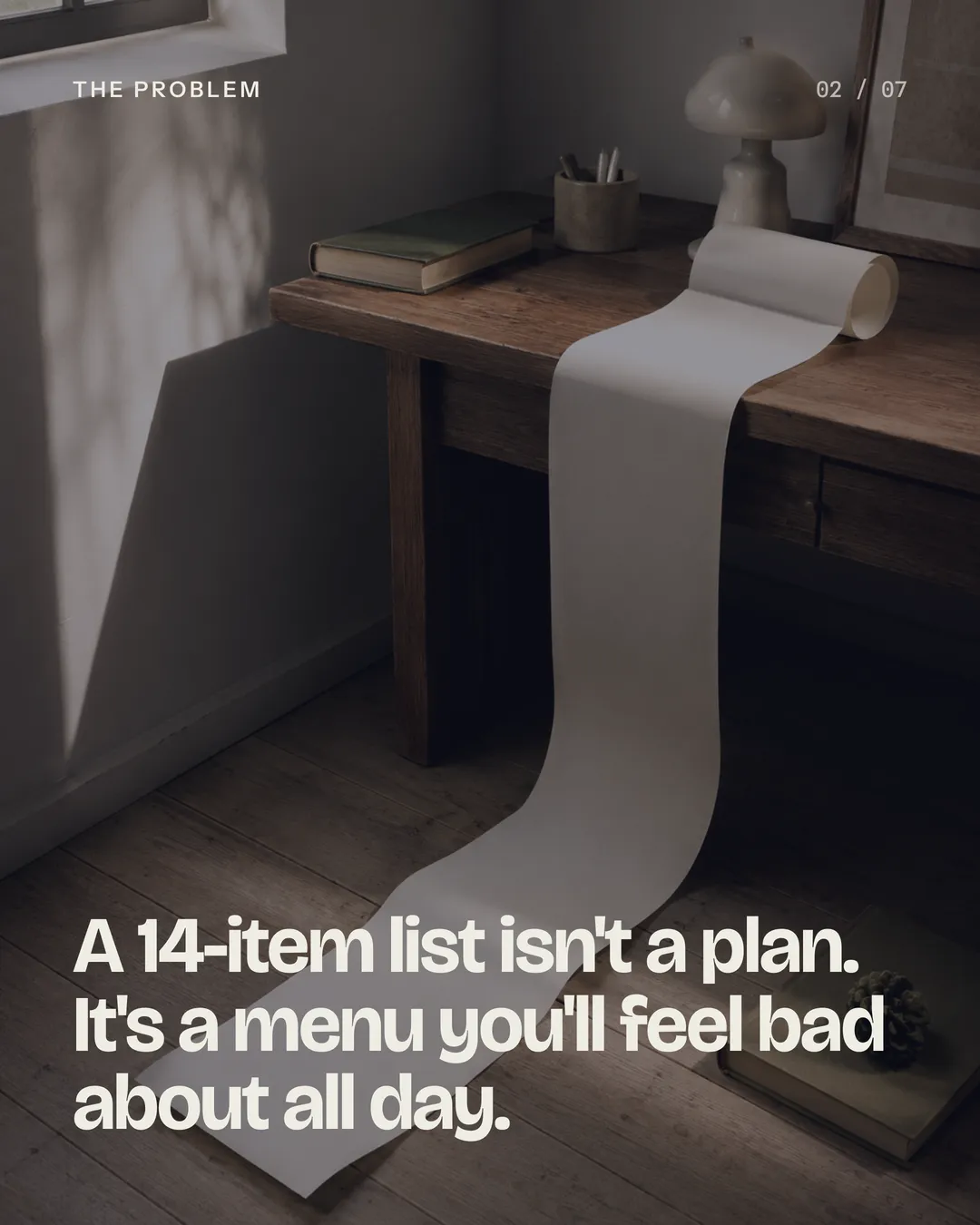
A 14-item list is a menu
Most to-do lists are written by accumulation. Something comes up, it goes on. By the afternoon the list has 14 items, and nothing about the list says which of them you are meant to do first, or which of them you could skip without anyone noticing.
That is a menu, not a plan. A menu is a fine thing to have, but you don’t eat everything on it, and nobody feels virtuous at the end of a meal for having ordered fewer dishes than the menu offered. A long list works the same way in reverse: you finish six items, cross them off, and still look at eight that remain. The day ends with a verdict of “behind”, even though six things got done.
The three lines: what matters, what’s due, what’s quick
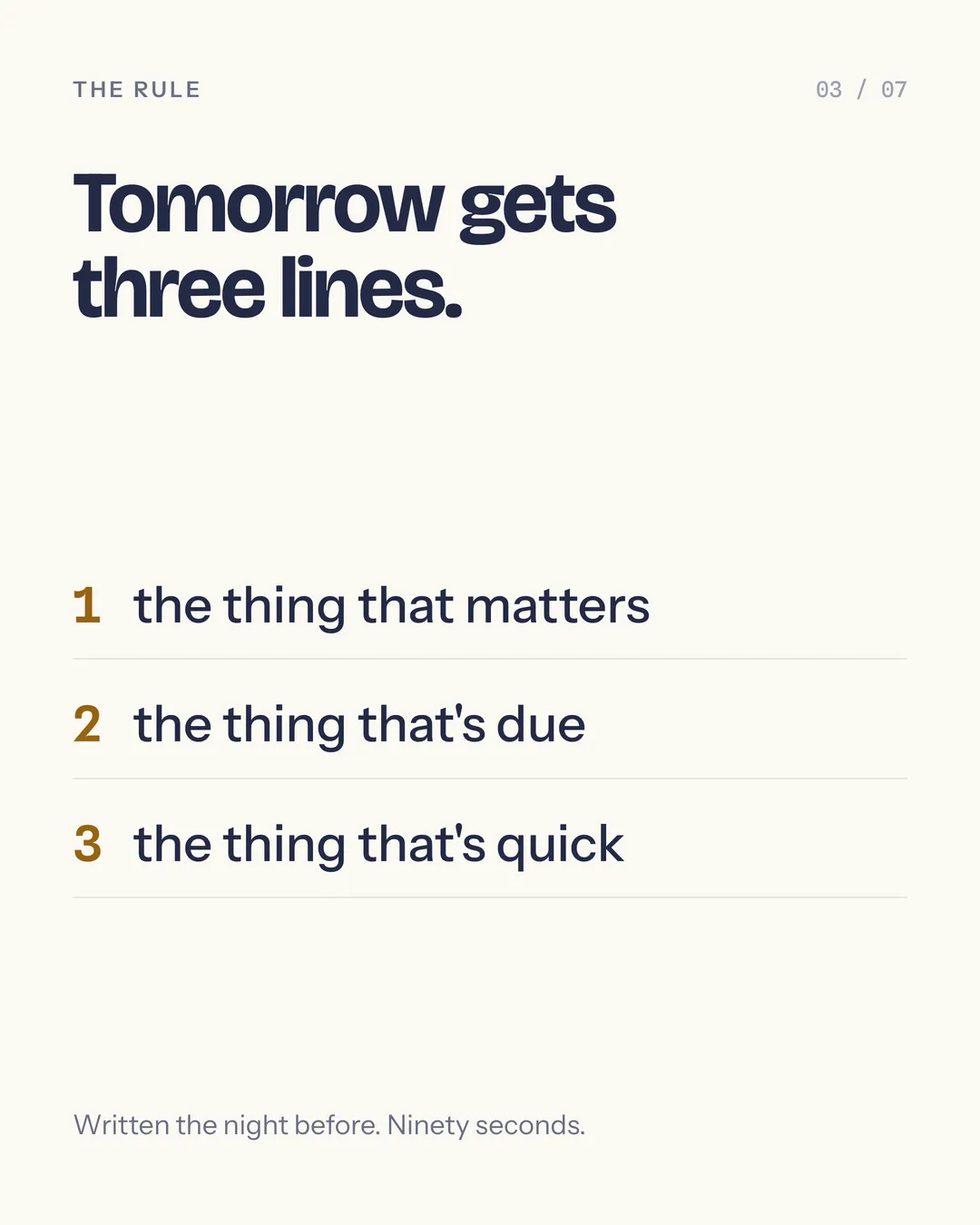
Tomorrow gets three lines, each with a different job.
- The thing that matters. The one task that, if it were the only thing you did, would make the day count. It is usually the one you’d prefer to postpone, because it is large or vague.
- The thing that’s due. Something with a deadline attached: a form, a reply, a payment, a delivery. It is on the list because someone else is waiting, not because you chose it.
- The thing that’s quick. A task under about 15 minutes that you’ve been carrying around. Its job is to clear a small weight and give the day an early finish line.
The three are different kinds of task on purpose. A list of three important things is still a list of three things that all want your best hours. Mixing the kinds gives the day a shape: one stretch of real work, one obligation, one small win.
Write them the night before. In the morning you then arrive at a decision already made, and the first ten minutes go on starting instead of choosing. Scheduling your energy rather than your hours is a natural next step: put the line that matters where you think best.
How many tasks should be on a daily list?
Three is the answer this post gives, and the reason is practical rather than scientific: three lines make a day finishable, and a finished day is what makes you trust the list tomorrow.
Trust is the part that gets skipped. If you finish a plan on most days, you start believing the next one. If you almost never finish yours, you stop treating the list as a plan and start treating it as a wish list, and you stop reading it closely, which is exactly when things slip. A short list that gets done is worth more than a long one that is mostly abandoned, because the short list keeps its authority.
Three is not a law. If your days are made of interruptions, two might be honest. If you have a quiet job and a free afternoon, four. The rule is the cap: a number small enough that you can see the whole day at once.
What to do with the rest: the someday list
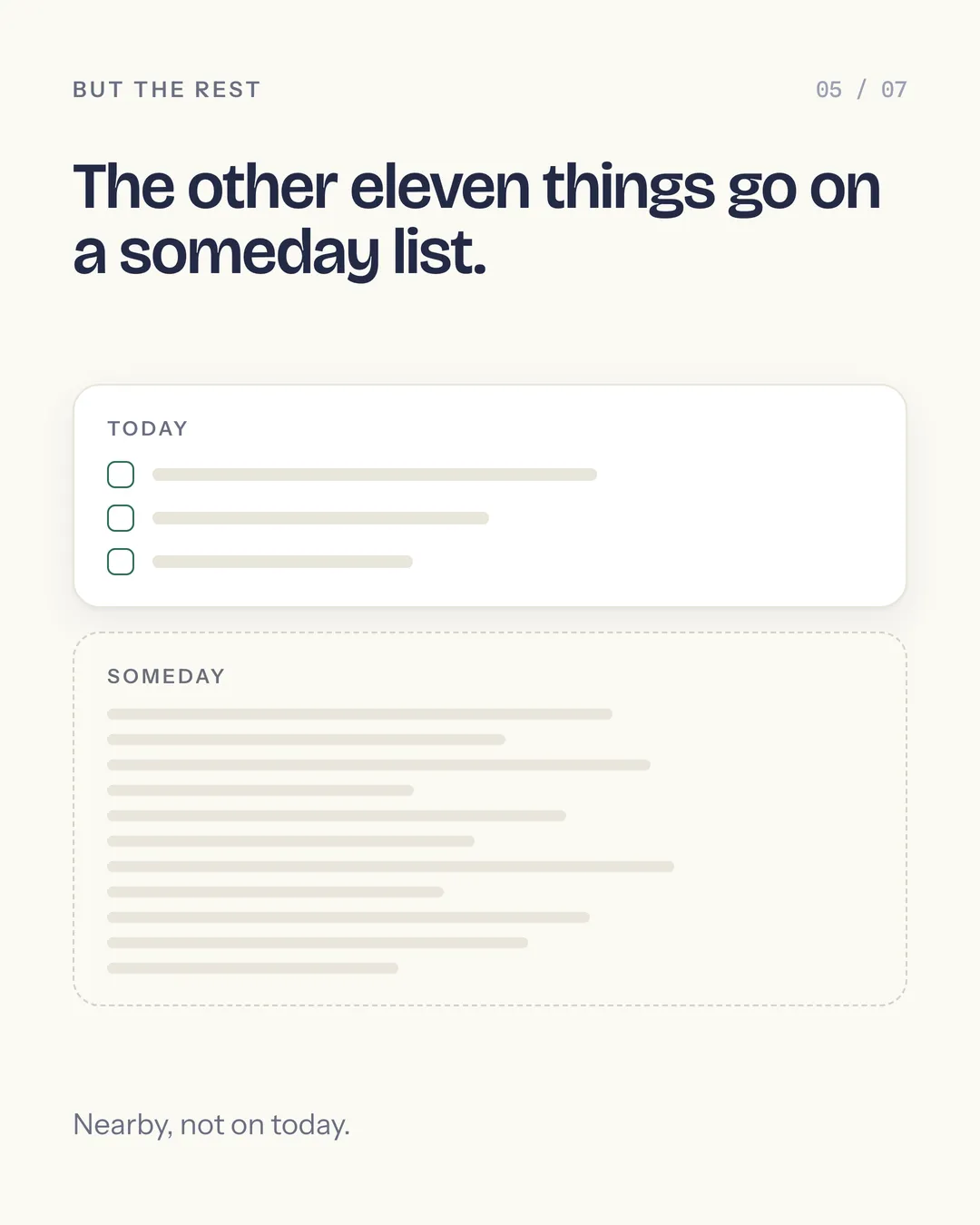
Your list had 14 items. Three went on the card. The other 11 do not disappear, and they shouldn’t, because a list you suspect is being quietly thrown away is a list you keep re-adding to.
They go on a someday list: nearby, not on today. Any place you can see works, whether that’s a page in the same notebook or a second card. The only requirements are that it is somewhere you trust, and that today can’t read it. Nothing on it is a promise for today.
Unfinished things have a way of nagging, which is its own subject; the Zeigarnik effect post covers it. The short version for planning is that writing a task down somewhere it will be found is part of what lets you stop carrying it.
The someday list needs an occasional tidy, since it will grow. A 15-minute weekly review is a good place for that: promote what has become due, delete what no longer matters.
Rewriting the list isn’t planning
There is a counterfeit of all this, and most people have produced it. You take a fresh page. You write a heading, perhaps in better handwriting than usual. You copy across the same twelve items from the old page, in the same order. It feels like progress because a page got tidier and something got written.
Nothing was decided. The twelve items arrived unchanged, and they will be there tomorrow, ready to be copied again.
The test is simple: after you’ve planned, can you say which one thing you’ll do first? If the answer is “whichever I get to”, you rewrote the list. The way out is small. Pick one item, circle it, and do it imperfectly. The other eleven will still be there, which is the point of having a someday list: nothing is lost by not copying them.
What if you finish all three by lunch?
Pull one more up from the someday list.
The wording matters here. A task you choose to pull up feels different from a task that was owed to you from the start. Same task, different day: one version is volunteering, the other is a debt. If you plan 14 items, the first thing you do all morning is fall behind. If you plan 3 and finish them by lunch, you’re ahead, and the fourth is a bonus you picked.
Do not add the fourth to tomorrow’s card in advance, and do not pad today’s card to guard against finishing early. The cap holds, and the surplus is yours.
Three, six or nine: the Ivy Lee method and the 1-3-5 list
If you search for daily planning methods, two named ones come up often. Both are practices people share, not research findings, and both cap the list, which is the idea three lines borrows.
The Ivy Lee method is usually told as follows. At the end of each work day, write down the six most important things for tomorrow, and put them in order of importance. Next day, work on the first until it is finished, then move to the second, and so on. Whatever is left over moves onto a new list of six for the following day. It is usually attributed to Ivy Lee, a consultant, advising Charles M. Schwab of Bethlehem Steel in 1918, and the telling is an anecdote: James Clear writes that he had trouble finding an original source and that the earliest reference he found dates from the 1960s. Enjoy the story, but don’t treat the details, and certainly not the payment, as established.
The 1-3-5 list is usually credited to Alex Cavoulacos of The Muse, who first described it in a blog post and later in the book The New Rules of Work. Each day has nine items: 1 big task, 3 medium ones and 5 small ones. Todoist’s guide to the method sizes them at roughly 2 to 4 hours, 30 to 60 minutes, and 5 to 15 minutes, and suggests setting the list the evening before.
| Items | What decides the list | Order | |
|---|---|---|---|
| Three lines | 3 | Matters, due, quick | Your call |
| Ivy Lee | 6 | Importance | Ranked, one at a time |
| 1-3-5 | 9 | Size of task | Big first, by suggestion |
The three differ in what they are sorting by. Ivy Lee ranks by importance and asks for strict sequence. The 1-3-5 list sorts by size, so a day contains work of every weight. Three lines sorts by role, and asks the least of you: no ranking beyond a clear first line, no budget of hours.
None is the right one. A reasonable way to choose is to look at how your last week actually went. If you routinely ran out of day at the fifth thing, take Ivy Lee’s six and trim it. If your days are full of small errands that crowd out the big task, the 1-3-5 structure gives the errands a place to live. If nothing has ever survived the afternoon, start with three, and add lines only when you have finished everything for a week.
Try it tonight
Take an index card. Write three lines: the thing that matters, the thing that’s due, the thing that’s quick. Put the other items, however many there are, on a second card or a lower part of the page, and label it someday. Put the card where you’ll see it first thing tomorrow.
In the morning, start with line 1. At the end of the day, notice only one thing: whether you finished.
Sources
- Clear, J. The Ivy Lee Method: The daily routine experts recommend for peak productivity. jamesclear.com. https://jamesclear.com/ivy-lee
- Todoist. How to plan your day with the 1-3-5 method. Todoist Productivity Methods. https://www.todoist.com/productivity-methods/1-3-5-method